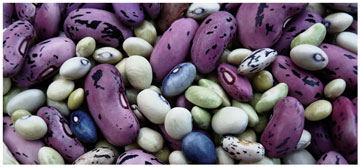
Merkmale
- Bohnensorten und Wuchsformen
- Buschbohne (Phaseolus vulgaris var. nanus)
- Farbanzahl
- einfarbig
- Grundfarbe
- rosa bis rosabraun
- weitere Farbe
- Musterung
- Blütenfarbe
- Korngröße (getrocknet im Durchschnitt)
- Kornform
Diese Sorte wurde am 24.02.2018 von saritabee hinzugefügt. Sie wurde 1 mal geändert, zuletzt am 26.02.2018 von saritabee.
Bilder hochladen
Kommentare
Um Kommentare zu hinterlassen, müssen Sie sich anmelden!
From Baker Creek Heirloom Seeds:
"The precise origin of this rare landrace is unknown although it has been grown in Central America and southern Mexico for several centuries. It was introduced to European gardeners by the French seed firm of Vilmorin, hence its alternate name in French. However, The Garden, a nineteenth-century English horticultural journal, reported in an 1874 edition that the Mexican Salmon Bean was already well-known to growers in Britain. Its Victorian popularity was based on its short growing season, prolific production of beans, visually striking pods, and the silken texture of the pale salmon-buff beans when cooked. In Latin American cuisine the Salmon Bean was a common addition to rice. It also makes a delicious type of refried bean. The bean was initially introduced as a bush variety for small gardens, but as The Garden noted, the plants send up 3-foot runners so it should be treated as a semi-pole bean. In southern Mexico where it originated, it was planted as a corn hill bean around short corn varieties. However, most of the 4-inch bright crimson pods are produced low on the vine, primarily in the “bush” part of it close to the central stem. We recommend growing the bean on stakes or a 3-4 foot trellis rather than let the plants ramble over the ground because dampness from summer rains can ruin pods touching the soil -- this also invites opportunistic insect damage. The tiny green pods can be harvested as snap beans, but once they turn crimson red, they should be allowed to dry on the vine. Pods ripen for dry beans in 65 to 75 days. Our seed stock originated in the cool hill country around Matagalpa, Nicaragua."
saritabee
-
26.02.2018